Why Your Website Needs a CRM Behind It (Not Just a Contact Form)
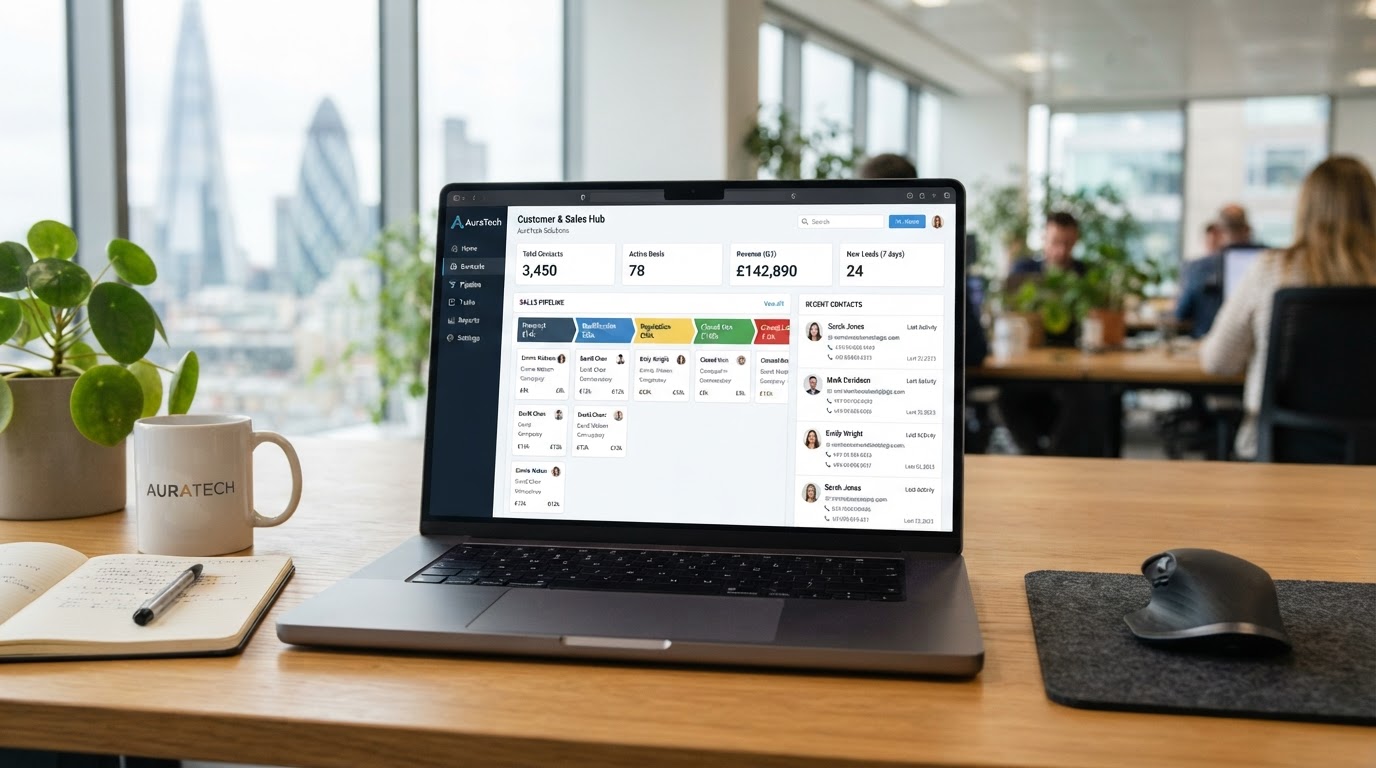
A lot of local businesses pay for a nice website, add a contact form, and then wonder why they are still chasing leads in a spreadsheet. The website looks good, but it does not actually work for the business. The missing piece is almost always a CRM behind it.
Your website is the front door. A CRM is the system that catches everyone who walks through it, remembers them, and makes sure nobody slips away. Without one, your website is a leaky bucket — and the leaks are usually leads you already paid good money to attract.
This is one of those problems that is easy to underestimate because it is invisible. You do not see the leads you lose. You only see the ones that make it through. So let's walk through exactly why a website on its own leaks, what a CRM actually does behind it, and how the two fit together to form a system that works while you are busy doing the actual job.
The Problem with "Just a Website"
A standard contact form sends an email. That email lands in an inbox you might check at the end of a long day, or forget about entirely when you are tired. Meanwhile, the customer who filled it in has already moved on and called the next business on the list. By the time you reply the next morning, the job is gone.
This is the gap that costs local businesses money. You spend on marketing to make the phone ring and the forms fill in, then lose the lead because there is no system to catch it. It is not a marketing problem — your marketing worked. It is a capture and follow-up problem, and it is entirely fixable.
Think about the journey from the customer's side. They searched, found you, liked what they saw, and trusted you enough to fill in a form. That is a lot of goodwill already earned. Then they wait. And wait. And eventually, because they need the job done, they go back to Google and call someone else. From their point of view, you never replied. From yours, you were just busy. Both are true, but the customer's experience is the one that decides who gets the job.
What a CRM Actually Does Behind Your Website
A CRM is not just a fancy address book, and it is not just software for sales teams in big offices. Connected to your website, it does the work that a human would forget to do — reliably, every time, without needing a reminder.
Captures Every Enquiry Automatically
Every form submission, message, and missed call becomes a contact in your CRM. Nothing depends on you remembering to check an inbox or scroll back through your phone. The moment an enquiry arrives, it exists in a system, with a timestamp, a source, and a record of what was asked.
This matters more than it sounds. Most businesses cannot tell you how many enquiries they got last month, where they came from, or how many turned into jobs. A CRM answers all of that by default, because every enquiry is recorded the moment it happens.
Sends an Instant Reply
The moment someone enquires, they get a branded, automatic response. It acknowledges them, sets expectations, and stops them contacting a competitor while they wait. Read more about growing your business online.
"Thanks for your enquiry. We've received your message and will be in touch within the next few hours. If it's urgent, reply here and we'll prioritise it."
That single message does something important: it closes the gap between "I sent the form" and "someone is dealing with me." In local business, where customers are often comparing two or three options at once, that gap is where jobs are won and lost. An instant reply does not have to solve their problem — it just has to confirm they are not shouting into the void.
Organises Every Conversation in One Place
Emails, texts, form submissions, and even missed call text backs all land in one shared inbox. Anyone on your team can see the full history and pick up where you left off, without you having to brief them.
This is the difference between a one-person operation that breaks the moment you take a day off, and a business that can keep running. When every conversation lives in one place, handovers become trivial. "Can you deal with the Smith enquiry?" stops requiring a five-minute explanation of who Smith is and what they want.
Automates the Follow-Up
Most leads go cold because nobody follows up. It is not that businesses do not want to — it is that follow-up is the thing that always gets pushed back when the day gets busy. A CRM can send a friendly nudge automatically after a quote, a reminder before an appointment, or a review request after a job. See how automation saves businesses hours each week.
The follow-up is where most of the money is hiding. A customer who asked for a quote and went quiet is very often not rejecting you — they got distracted. A single well-timed message brings a surprising number of them back. Doing that manually for every quote is unsustainable; doing it automatically is trivial.
Tracks Where Every Lead Comes From
When every enquiry flows through one system, you can finally see which marketing actually works. You stop guessing and start investing in the channels that bring real jobs. This is the part that pays for the CRM many times over: most local businesses are spending money on at least one marketing channel that produces nothing, and they have no idea which one.
With source tracking, you can see that, say, your Google Business Profile brings in most of your calls while a particular paid ad brings clicks but no enquiries. That is not a guess — it is a number. And numbers let you make decisions instead of hoping.
Website + CRM: How It Fits Together
Think of it as a simple pipeline that runs itself, step by step:
- Visitor lands on your website
- They fill in a form or call
- The enquiry drops straight into your CRM
- An instant reply goes out automatically
- The lead is tagged, tracked, and assigned
- Follow-ups and reminders run on schedule
- The job is booked, completed, and a review is requested
That is a future proof business system, not just a website. Each step hands off to the next without anyone having to remember to do it. Read more about bringing your business into the future.
The beauty of this pipeline is that it works the same at 2pm on a Tuesday as it does at 11pm on a Sunday. The capture and the instant reply never sleep, which means a customer who finds you in the evening is not lost to the morning.
A Real Example: The Leaky Bucket in Action
Consider a typical local trades business. They have a decent website, a contact form, and a phone. They get maybe eight enquiries a week. Without a system, here is what actually happens to them:
- Three get a reply the same day and two of those become jobs.
- Two get a reply the next day, by which point one has already booked someone else.
- Two sit in the inbox, get forgotten over a busy weekend, and are never replied to.
- One was a missed call with no voicemail and no follow-up — gone entirely.
So out of eight enquiries, that business wins two jobs and quietly loses six. They blame their marketing for "not working," when in reality the marketing did its job — the business just had no system to catch what it produced. Now imagine the same eight enquiries with a CRM and instant replies: the two forgotten ones get an automatic reply and stay warm, the missed call gets a text back, and the late repliers are handled the same as the early ones. The number of jobs won from the same eight enquiries jumps dramatically, with no extra marketing spend.
Signs You Need a CRM Behind Your Website
If any of these sound familiar, a CRM behind your website is the fix, not another redesign:
- You lose track of who you have quoted and who you are still waiting on.
- Enquiries sit in an inbox for days before you reply.
- You have no idea which of your marketing actually brings in jobs.
- Follow-up only happens when you remember to do it — which is rarely.
- Only one person knows where anything is, and that person is you, which means the business stops when you stop.
- You have had a customer say "I went with someone else because you never got back to me" — and you cannot even find their original message.
- You are paying for ads or SEO but cannot connect it to actual booked work.
It Does Not Need to Be Complicated
You do not need an enterprise system with a six-month implementation. Most local businesses just need a clean, reliable CRM that connects to their website, captures every lead, and automates the boring follow-up. A tailored CRM solution can be set up to match how your business actually works, rather than forcing you to work the way the software expects.
The goal is not more software. The goal is fewer lost leads, less admin at the end of the day, and a business that keeps running even when you are on the tools. A CRM is simply the tool that delivers that.
Conclusion
A website on its own is a brochure. A website connected to a CRM is a system that captures, organises, and converts every enquiry. If you are tired of leads slipping through the cracks, the fix is not a prettier website. It is the system behind it — the one that catches every enquiry, replies instantly, follows up automatically, and finally tells you which of your marketing is actually paying for itself.
Ready to stop losing leads? Get in touch and we will connect your website to a CRM that actually works for your business.