Lead Capture: How to Stop Losing Enquiries From Your Website
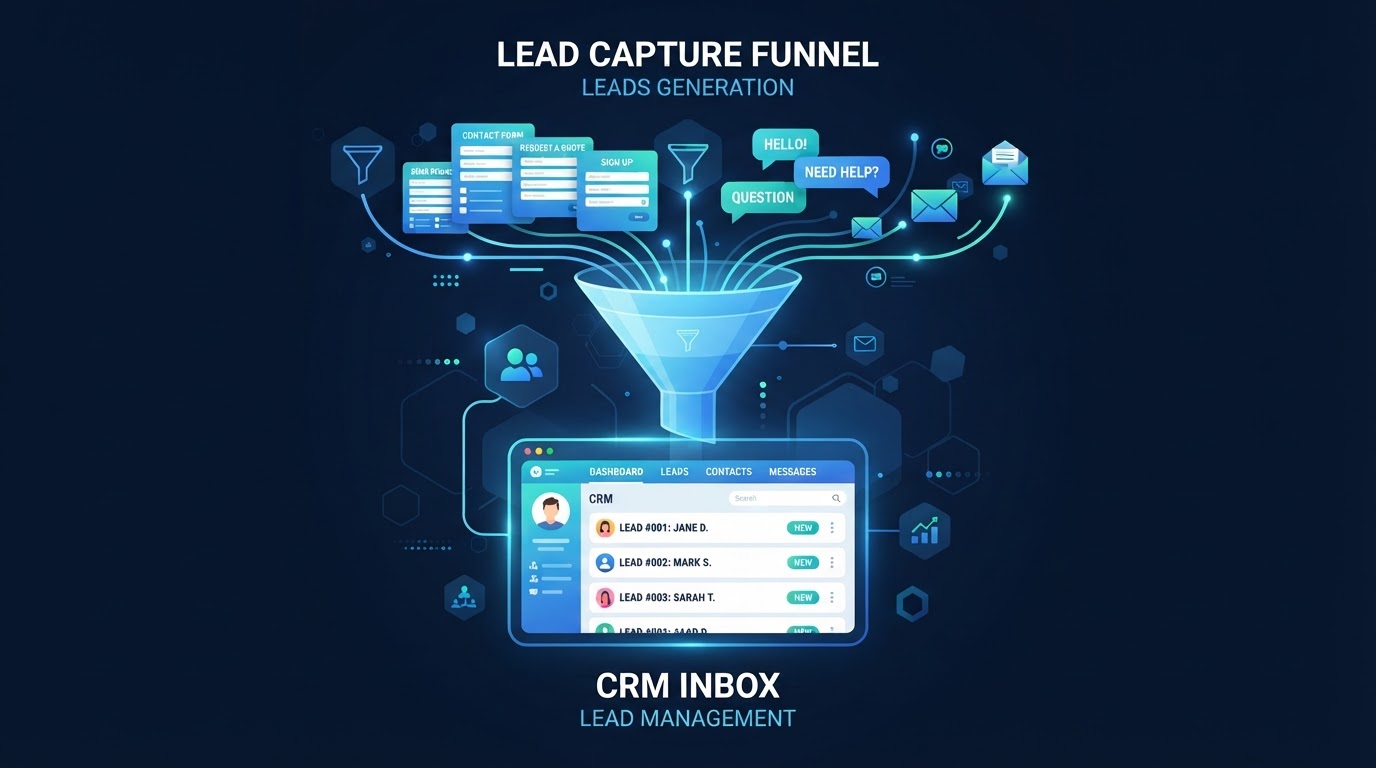
Here is the uncomfortable truth for most local businesses: you are probably losing leads you already paid for. You spend on a website, on ads, on local SEO, and on getting found. Then a visitor fills in a form, the email sits in an inbox, and by the time you reply, they have booked someone else. The marketing worked. The capture did not.
That is a lead capture problem, and it is fixable. Lead capture is the system that catches every enquiry the moment it arrives, replies instantly, and makes sure nothing slips away. This guide shows you how to set it up properly — not as a single tactic, but as a system that runs whether you are at your desk or up to your elbows in the actual work.
Why Traffic Without Capture Is Wasted Money
Getting people to your website is only half the job. If they arrive, look around, and leave without making contact, that traffic was wasted. A pretty website with no capture system is a leaky bucket — and the leaks are the most expensive part, because those visitors cost you real money to attract.
The goal is simple: turn more of the visitors you already have into actual enquiries, and turn more of those enquiries into booked jobs. Read more about growing your business online. Before you spend another pound on getting more traffic, it is almost always more cost-effective to fix the capture first — because improving capture multiplies the value of every visitor you already get, while buying more traffic just sends more people into the same leaky bucket.
Think of it as a funnel with two ends. Most businesses obsess over the top — getting more people in — and ignore the bottom, where most of the leakage happens. Plugging the holes at the bottom is cheaper and faster than pouring more in at the top.
The Three Parts of Good Lead Capture
Good lead capture is not one thing. It is three things working together: making it easy to enquire, catching every channel in one place, and replying instantly. Miss any one of the three and the system leaks.
1. Make It Easy to Enquire
Every friction point costs you leads. Make contacting you the easiest thing on the page, not an afterthought tucked in the footer. The businesses that capture best make the path from "I am interested" to "I have contacted you" as short as humanly possible.
- Have a clear call to action above the fold, so visitors do not have to scroll to find how to get in touch.
- Use short forms that ask only for what you need to reply. Every extra field reduces the number of people who finish it.
- Make your phone number and "book now" button large and easy to tap on mobile, where most local searches happen.
- Offer more than one way to get in touch: form, call, and message. Different customers prefer different channels, and forcing one loses the others.
- Remove anything that makes people hesitate — required fields they do not understand, captcha puzzles, or pages that load slowly.
2. Capture Every Channel in One Place
Enquiries come from everywhere: website forms, phone calls, messages, and missed calls. If they all go to different places, leads get lost — because no single person is watching all of them, and no single system knows about all of them. A CRM brings them into one shared inbox so nothing depends on one person remembering.
This is the part most businesses get wrong, because it is invisible. You do not see the lead that called while you were on another call and did not leave a voicemail. You do not see the message that went to a Facebook inbox nobody checks. Bringing every channel into one place makes those invisible losses visible — and once they are visible, they are fixable.
3. Reply Instantly
Speed wins. The business that replies first usually gets the job, especially in local services where customers are often comparing two or three options and just want someone to say yes. An automated instant reply acknowledges the enquiry, sets expectations, and keeps the customer engaged while you get free to respond properly.
"Thanks for getting in touch. We've received your enquiry and will be back to you shortly. If it's urgent, just reply to this message."
The instant reply does not need to solve the problem. It needs to do one thing: confirm that the message arrived and that a human will deal with it. That single confirmation is what stops the customer from going back to Google and calling the next business. You would be amazed how many jobs are won purely by being the first to say "we have got your message."
How a Lead Capture System Works
Once set up, the whole thing runs in the background, the same way every time:
- Visitor fills in a form or calls your website
- The enquiry drops straight into your CRM
- An instant reply goes out automatically
- The lead is tagged and tracked by source
- A follow-up is scheduled if there is no response
- The job is booked and a review is requested afterwards
That is a system, not a hope. Read more about why your website needs a CRM behind it. The point of a system is that it does not depend on you having a good day. It captures the same way at 9am and at 9pm, on a quiet Monday and on a frantic Friday.
Don't Forget the Phone
For local businesses, the phone is still one of the biggest lead sources — often the biggest. But a missed call is a lost lead if there is no safety net, and missed calls are inevitable when you are on the tools. Add missed call text back so every unanswered call gets an instant text reply, turning a dead end into the start of a conversation.
It is easy to focus on the website and forget that for many local customers, calling is still the most natural thing in the world. They search, they see your number, they call. If you do not answer and there is no text back, that is a lead gone — often a ready-to-buy lead, because people who call are usually further along than people who fill in a form.
Common Lead Capture Mistakes
- Long forms: Every extra field reduces the number of people who finish it. Ask for name and contact details; get the rest in the conversation.
- Slow replies: A reply hours later is often too late in local services. The instant automated reply buys you the time to respond properly without losing the lead.
- No follow-up: One quote and silence lets leads go cold. The fortune is in the follow-up, and it should be automated so it actually happens.
- Enquiries scattered everywhere: If leads live in an inbox, a phone, and a notebook, some will be missed. One system, one inbox, one source of truth.
- Ignoring the phone: Treating missed calls as unimportant loses ready-to-buy customers. A missed call with a text back is a captured lead; a missed call with nothing is a lost one.
- No source tracking: If you cannot tell where your leads come from, you cannot tell which marketing is worth keeping and which is wasted money.
- Hiding the contact options: Burying your form or phone number costs you leads you would otherwise have won for free.
How to Measure It
Once your capture system is in place, track a few simple numbers. You do not need a complex dashboard — you need to know whether the system is catching what it should:
- Enquiries received: How many leads are actually coming in, across every channel.
- Response time: How fast the first reply goes out (it should now be instant).
- Enquiries converted: How many turned into booked jobs, not just conversations.
- Lead source: Where your best leads come from, so you can do more of what works and less of what does not.
- Leads recovered: How many previously-lost leads (missed calls, late replies) now turn into conversations thanks to the safety net.
When you can see these numbers, you stop guessing and start improving. Pair lead capture with smart AI automation and you have a system that works while you are busy on the tools — and that tells you, in numbers, whether it is working.
The Compounding Effect of Good Capture
The best thing about fixing lead capture is that the gains compound. Better capture means more leads from the same traffic, which means your marketing becomes more profitable, which means you can afford to do more of it, which brings more traffic that your now-fixed capture system converts efficiently. The opposite is also true: a leaky bucket makes every pound of marketing spend less effective, so you end up spending more to stand still.
This is why capture should almost always come before more traffic. It is the highest-returning investment you can make, because it multiplies the value of everything you already spend.
Conclusion
You already pay to get people to your website. The question is whether you catch them when they arrive. Good lead capture makes it easy to enquire, brings every channel into one place, replies instantly, and follows up automatically. Do that, and you stop losing the leads you already paid for — and you turn the traffic you are already buying into the booked jobs it was always meant to produce.
Ready to capture every enquiry? Book a free setup call and we will build a lead capture system around your business — forms, phone, follow-up, and the CRM that ties it all together.